Featured Publication: Corporate Crimes Handbook
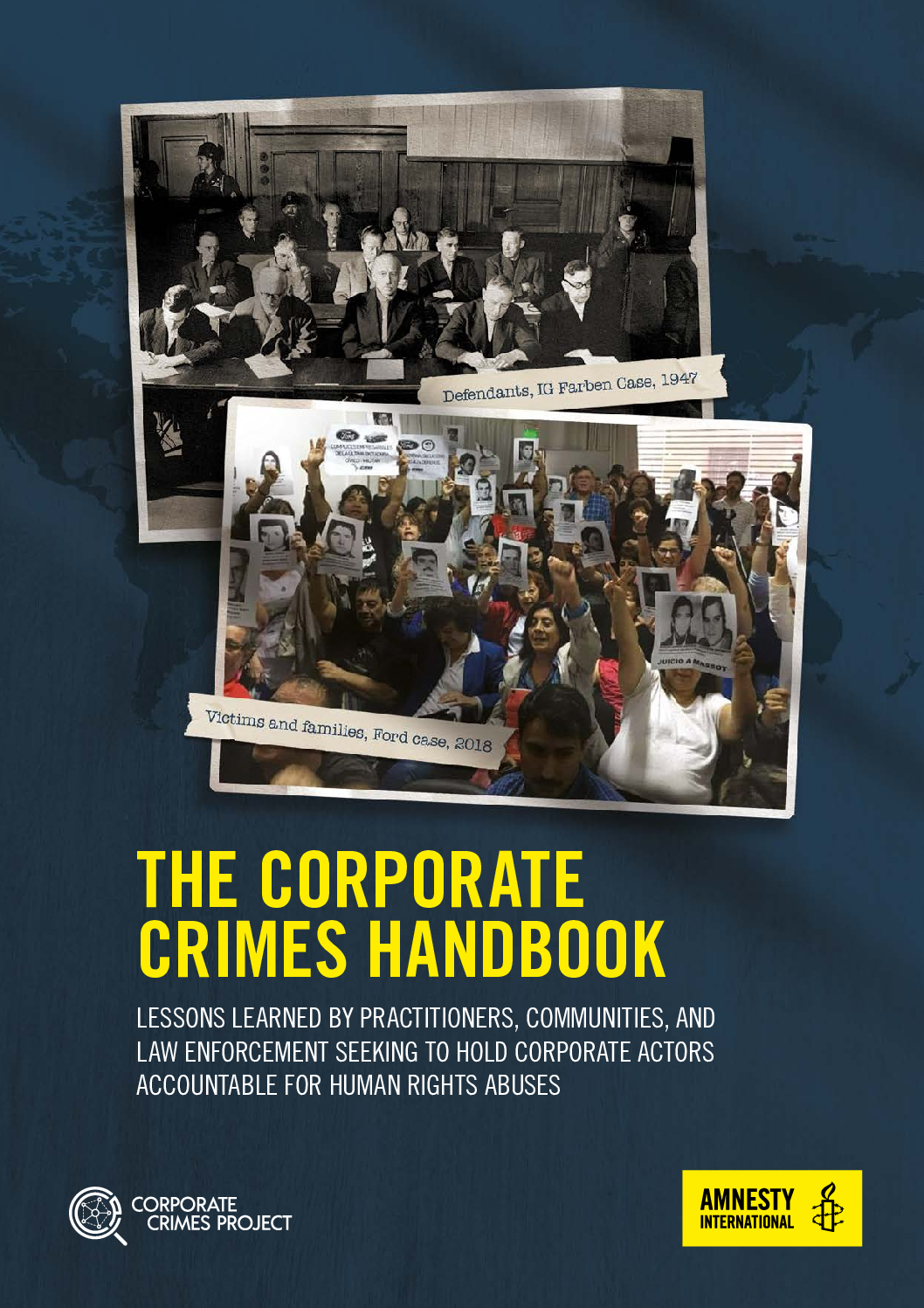
Following a nearly two-year study, I authored the Corporate Crimes Handbook, published by Amnesty International, which compiles insights and lessons learned from practitioners, communities, and law enforcement involved in corporate crimes cases.
We conducted consultations with 46 stakeholders involved in nearly a dozen case studies from around the world including the Lundin case in Sweden, the Lafarge cases in France and the USA, the Chiquita cases in Colombia and the USA, the Ford case in Argentina, the La Fronterita case in Argentina, the Volkswagen case in Brazil, the Union Carbide cases in India and the USA, the Metssa case in the Republic of Congo, the Shell cases in the Netherlands, and the Shell, Eni, and Malabu cases in multiple other jurisdictions. Drawing from the findings of these consultations, we discerned the lessons presented in this Handbook, which were reviewed and generally endorsed by the Members of an Expert Committee that advises Amnesty's Corporate Crimes Project.
Academic Publications
Otherwise Occupied: The Legal Status of the Gaza Strip 50 Years After the Six-Day War
This article examines the legal status of the Gaza Strip under international law, fifty years after Israel's occupation began during the Six-Day War. The analysis addresses whether Israel continues to occupy Gaza following its 2005 disengagement, applying international humanitarian law as applicable to belligerent occupation to the facts on the ground from 2005–2018. The article challenges conventional wisdom by arguing that while control of Gaza's periphery cannot amount to an occupation, the Israeli military's ability to exercise its authority in the Gaza Strip within a reasonable time can. By taking a dynamic approach to assessing the legal status of Gaza, this article reveals a trend whereby the Israeli military was able to exercise its authority in the Gaza Strip more rapidly with each armed conflict after the disengagement. It concludes that although Israel no longer occupied the territory as of its disengagement in 2005, it re-occupied nearly all of Gaza by 2014. As a consequence, this article determines that the armed conflict between Israel and Hamas is of an international character and persists to this day. The legal and policy implications for Israel, Palestine, and the international community are profound.
The article won the Virginia Journal of International Law's Human Rights Writing Competition in 2017.
Read on SSRN →Too Clever by Half: Why the ICC Will Probably Find No Jurisdiction Over the Deportation of the Rohingya
This legal analysis examines the International Criminal Court Prosecutor's novel jurisdictional argument regarding the alleged deportation of the Rohingya from Myanmar to Bangladesh. The article critically assesses whether the Court's assertion of jurisdiction over crimes committed by nationals of a non-State Party in their own territory represents a legitimate interpretation of the Rome Statute or an impermissible expansion of the Court's mandate.
While sympathetic to the goal of bringing justice to the Rohingya, the article argues that the Prosecutor's jurisdictional theory risks undermining the Court's legitimacy by appearing to rewrite the Rome Statute to grant itself power over non-States Parties, potentially provoking backlash from states and weakening the international criminal justice project.
Read on Opinio Juris →